


DC Motor Controller IC: Features, Working & Applications
 252
252What Is a DC Motor Controller IC?
A DC motor controller IC is an integrated circuit specifically dedicated to the control and management of the operation of direct current motors and regulates and controls the operation of direct current motors; controlling parameters of speed, direction, torque and current flow in electronic systems and is a fundamental component in more recent embedded systems where precise motor control is needed such as robotics and automation, and is a core component in consumer electronics and industrial machinery.
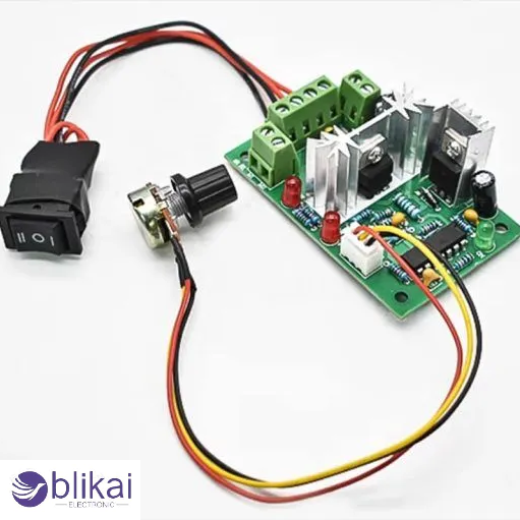
How a DC Motor Controller IC Works
A DC motor controller IC is an electronic device that takes input control signals in the form of PWM (pulse width modulation), analog voltage, or digital commands (as input in a microcontroller) and converts these inputs into controlled switch actions within an internal or external H-bridge configuration that controls the voltage and current to the motor, thereby controlling its speed and direction, with more advanced ICs including feedback mechanisms such as current sensing or closed-loop control to guarantee stable operation under varying loads, ensuring efficient energy usage and consistent motor performance across different operating conditions.
PWM Speed Control Principle
The most often method employed in DC motor controller ICs to control motor speed is pulse width modulation, which varies the average voltage sent to the motor by changing the percentage of the switching signal that is active in each switching cycle, since it can smoothly change motor speed (with no important effects on torque characteristics or heat generation) and offers a very fine resolution of speed.
Direction Control Using H-Bridge
Direction control in DC motor systems DC motor systems generally use an H-bridge circuit that is driven or driven by the controller IC to provide forward and reverse movement and by switching between different pairs of switches in the H-bridge the IC provides safe and efficient directional movement and avoids short-circuits by dead-time control and internal protection logic.
Current Limiting and Protection Mechanisms
Modern DC motor controller ICs have extensive protection, including overcurrent protection, overvoltage protection, thermal shutdown and undervoltage lockout as well to protect the motor and the electronic system itself, and these features constantly check the operating conditions and automatically adjust or shut off the system in case of abnormal conditions, thereby preventing damage, enhancing reliability, and increasing the life cycle of the entire device.
Key Features of DC Motor Controller ICs
DC motor controller ICs are developed with a large number of functions that improve the performance and ease of use, such as a wide input voltage range to accommodate a variety of power sources, a high current driving capability to meet the power needs of demanding loads, built-in H-bridge drivers to make circuit designs simpler, low standby power consumption to be energy efficient, in-built diagnostic and fault detection system to increase the reliability, and flexible control interface including PWM and digital communication, all of which make them highly versatile for different applications.
Types of DC Motor Controller ICs
DC motor controller ICs may be classified by motor type/function with brushed DC motor controller ICs being simpler and common in low-level applications, and brushless DC (BLDC) motor controller ICs being more efficient and requiring less maintenance with more complex multi-channel controls needed in multi-motor systems like robotic platforms and automation.
Typical DC Motor Controller IC Circuit Design
A typical circuit of a DC motor controller IC can be described as a power supply stage, input control interface, and output driver stage with the IC taking control signals at an input and driving the motor at an output; other elements like flyback diodes, capacitors, resistors are used to stabilize the circuit and reduce electromagnetic interference and to ensure reliable operation and good PCB layout practices are the key to minimizing noise and enhancing thermal performance.
Applications of DC Motor Controller ICs
DC motor controller ICs are ubiquitous in numerous industries and robotics and automation systems, where fine motor control is needed; automotive, such as power windows and seat adjustment and cooling fans; consumer electronics, such as printers, fans and appliances; industrial equipment, such as conveyors and CNC machines, and IoT devices, where compact and energy-efficient motor control platforms are essential to smart and connected systems.
Advantages and Disadvantages of DC Motor Controller ICs
The benefits of DC motor controller ICs are that it is small, easy to design, highly reliable, and efficient with the drawbacks being that it may be difficult to dissipate heat when using high-power ICs, current limitation in low cost ICs and external components may be necessary in some designs, so this requires careful choice and engineering decisions to ensure the best performance.
How to Choose the Right DC Motor Controller IC
In choosing the right DC motor controller IC, one must consider the voltage and current needs of the motor, preferred form of control (PWM or analog) to select an efficient and thermally suitable controller, type of package, and protection options, and take into account the application-specific considerations of size, cost, and compatibility with the control architecture of the system, to ensure that the selected controller has adequate performance and thermal performance.
DC Motor Controller IC vs Discrete Motor Driver Circuits
The DC motor controller ICs have major benefits over discrete motor driver circuits in terms of integration, lower design complexity, and higher reliability, whereas discrete solutions have a higher level of flexibility and customization to more specific applications, so IC-based solutions are more acceptable in most current designs where efficiency, compactness, and ease of implementation are considered most important.
Design Tips for Using DC Motor Controller ICs
In DC motor controller IC design, appropriate heat management techniques, such as thermal vias and heat sinks, adequate power supply decoupling to maintain noise levels low, EMI suppression measures to maintain interference levels to a minimum and safe startup and shutdown regimes to aid in avoiding noise are relevant to ensure that the motor and the control circuitry operate in a stable and efficient fashion.
RT8131BGQW vs RT8813DGQW IC Comparison Table
|
Parameter |
||
|
Manufacturer |
Richtek |
Richtek |
|
IC Type |
Buck PWM DC-DC Controller |
Advanced PWM Controller |
|
Primary Function |
Step-down voltage regulation |
Multi-function PWM control |
|
Input Voltage Range |
5.5V – 26.5V |
Wide (application dependent) |
|
Control Topology |
Synchronous buck |
PWM controller (external MOSFETs) |
|
Switching Frequency |
~300kHz |
Adjustable / higher frequency capable |
|
Output Current |
Up to ~6A (design dependent) |
External MOSFET dependent |
|
Efficiency |
High |
High (design dependent) |
|
Protection Features |
OCP, OVP, UVLO, OTP |
OCP, OVP, UVLO, thermal protection |
|
Package Type |
WDFN-10 (3×3 mm) |
WQFN-24 |
|
Integration Level |
Medium |
Higher flexibility and scalability |
|
Typical Applications |
DC-DC converters, embedded power |
Advanced power systems, motor-related control |
|
Design Complexity |
Moderate |
Higher (requires external components) |
Conclusion
DC motor controller ICs are then highly valued in the current electronics world by being efficient, reliable and compact solutions to motor control and it is important to know how they work, their features and when they are used best to ensure that smarter, efficient and highly reliable motor driven applications can be achieved in a broad spectrum of industries.
FAQ
Can I control motor speed with a DC motor controller IC?
Yes, typically using PWM signals for efficient speed regulation.
What is the difference between brushed and BLDC controller ICs?
Brushed controllers are simpler, while BLDC controllers offer higher efficiency and longer lifespan.
Do DC motor controller ICs support reverse rotation?
Yes, via H-bridge configurations.
Are DC motor controller ICs suitable for embedded projects?
Yes, they are popular in microcontroller and IoT applications.
Some images are sourced online. Please contact us for removal if any copyright concerns arise.





