


Passive Infrared Sensor (PIR) Guide: Working, Types & Applications
 674
674What Is a Passive Infrared Sensor (PIR)?
A Passive Infrared Sensor (PIR) is a kind of electronic sensor that is used to sense movement by sensing variations in the infrared radiation emitted by the objects in the sensor field of interest. Otherwise passive as opposed to active sensors, PIR sensors do not emit energy, but absorb infrared waves, and are therefore exceptionally energy efficient and suitable for battery-driven electronics, security systems, automation equipment, and Internet of Things systems.
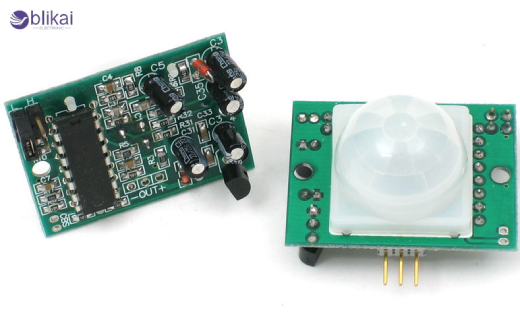
How Does a PIR Sensor Work?
PIR sensors are used to check the changes in the infrared radiation due to the movement of objects, particularly the heat produced by the human body. As a warm object passes through the sensor in its detectable regions, the pattern of the infrared energy varies, producing an electrical signal that causes movement detection.
A pyroelectric material in the middle of the PIR sensor generates a small amount of voltage when subjected to varying levels of infrared. The infrared radiation is focused on the sensing element using a Fresnel lens, and the area of detection is subdivided into zones. The signal is amplified and processed by the internal circuitry in the sensor when there is motion between these zones, generating an output, either digital or analog.
Main Components of a PIR Sensor Module
The average PIR sensor module combines various electronic parts in order to guarantee sound motion detection. The pyroelectric sensor element transforms the change of infrared into an electrical signal, and the Fresnel lens increases the sensor's sensitivity and the area of detection. Signal conditioning circuits, including amplifiers and comparators, filter noise and convert weak signals into usable outputs.
The vast majority of PIR modules have a voltage regulator, timing control circuitry and sensitivity and delay time adjustable potentiometers. These integrated components allow PIR sensors to be easily connected to microcontrollers, relay modules, or alarm systems without complex external circuitry.
Types of Passive Infrared Sensors
Single-Element PIR Sensors
Single-element PIR sensors are pyroelectric sensors that are based on a single pyroelectric sensing element to detect an infrared radiation change due to a moving heat source. They are of very simple design, low-priced, however, more vulnerable to changes in ambient temperature, and are only applicable in simple indoor motion detection in stable conditions.
Dual-Element PIR Sensors
Dual-element PIR sensors employ two sensing elements with opposite polarity to cancel uniform background temperature changes while detecting motion. This design provides much better accuracy and has a lower rate of fake triggering, as a result of which dual-element PIR sensors have become the most popular types in security applications, lighting control and smart automation use cases.
Analog vs Digital PIR Sensors
Digital PIR sensors have signal conditioning circuits on board and a HIGH/LOW output, whereas the analog PIR sensors allow more sophisticated signal processing by means of their variable voltage output. Digital PIR sensors are easier to interface with microcontrollers and are more common in consumer electronics and IoT applications.
PIR Sensor Modules vs Bare PIR Elements
PIR sensor modules combine the sensing element, Fresnel lens, and processing circuitry into a ready-to-use unit, while bare PIR elements require external circuits for amplification and control. Modules are ideal for quick integration, whereas bare elements are preferred in custom and high-volume product designs.
Key Technical Specifications of PIR Sensors
The workings of PIR sensors are important in the selection and design of the system. The range of detection is normally between 3 and 12 meters, depending on the design of the lens and the sensitivity settings. The range of detection is normally 90deg to 180 ° and covers a large area.
Operating voltage usually falls between 3V and 12V, making PIR sensors compatible with Arduino, ESP32, and other low-power platforms. Output signals are generally digital logic levels, while response time and trigger delay can often be adjusted to meet application requirements. Low quiescent current is a major advantage for battery-powered systems.
Common Applications of PIR Sensors
Motion Detection and Security Systems
PIR sensors find extensive applications in motion detection and security systems as a means of detecting human movement because of the body heat. They are usually incorporated in the alarm system, intrusion sensors, and surveillance appliances because of their low power consumption, performance consistency, and lower false alarms than the active sensing technologies.
Automatic Lighting Control
PIR sensors allow automatic lighting systems to be activated whenever motion is detected, only when it is needed, and this increases energy efficiency and convenience to the users. They are often placed in halls, staircases and parking lots and outdoor lighting, where the motion detection is dependable in order to limit unnecessary power usage and increase the lamp life.
Smart Home and IoT Devices
PIR sensors are important in smart homes and IoT applications, offering occupancy and motion detection to systems connected, enabling the intelligent control of lighting, climate systems, and security functions with exceptionally low power consumption.
Industrial Automation and Energy Saving
PIR sensors are applied in industrial and commercial settings for presence detection, safety monitoring, and energy management. They assist in managing and regulating the work of machinery, activating safety lighting, streamlining the HVAC systems, because human activity is detected and the consumption of energy is reduced, as well as the overall efficiency of operations increases.
PIR Sensor vs Other Motion Sensors
PIR sensors use much less power and are also not as sensitive to environmental interference as microwave motion sensors are. But microwave sensors have the ability to sense movement even through thin walls, and PIR sensors do not. Ultrasonic sensors are dynamic and emit sound waves and receive reflections when used; hence, they are efficient in enclosed areas but most likely to produce false triggers.
How to Use a PIR Sensor in Electronic Circuits
Application of the PIR sensor in the electronic circuit is not complex, particularly when a pre-built PIR module is employed. These modules have a combination of three pins, VCC, GND and OUT predominantly. The microcontroller can be connected to a motion sensor by connecting the output pin directly to one of the microcontroller's GPIO pins.
By connecting to Arduino or any other MCU, it is possible to interpret motion signals using software and then activate actions, e.g., turning lights on or sending an alert. The sensibility and time delay are normally set using onboard potentiometers, and the equipment can be tuned to particular environments.
Typical Problems and Troubleshooting PIR Sensors
False triggering is a common issue with PIR sensors and is often caused by temperature fluctuations, direct sunlight, or airflow from heaters and air conditioners. Improper placement can also lead to unstable detection results.
PIR sensors must not be placed near heat sources or direct sunlight to increase reliability. False alarms can also be minimized by setting sensitivity and delay. But adequate power supply filtering and grounding also contribute towards the reduction of electrical noise.
How to Choose the Right PIR Sensor
The choice of the appropriate PIR sensor will be subject to the requirements of the environment and the system. PAIR sensors that work indoors are better suited to the more constant temperature conditions, but the outdoor sensors need the weatherproofing and sophisticated filtering.
Selection should take into account the following: detection range, angle, power consumption, and output type. Ultra-low-energy PIR sensors are the right solution in the case of batteries or IoT systems, but in the industrial system, the emphasis could be put on the long range of detection and the robust performance.
Frequently Asked Questions About PIR Sensors
Can PIR sensors detect through walls?
No, PIR sensors are not able to sense the movement behind the wall or solid surfaces since infrared radiation does not go through the opaque materials.
Do PIR sensors work in daylight?
Yes, PIR sensors function in both daylight and darkness since they detect infrared radiation rather than visible light.
What affects PIR sensor accuracy?
Ambient temperature, sensor placement, Fresnel lens design, and environmental interference all influence PIR sensor performance and accuracy.
Some images are sourced online. Please contact us for removal if any copyright concerns arise.





