


Tactile Sensor Explained: Working Principle, Types & Applications
 578
578What Is a Tactile Sensor?
A tactile sensor is a kind of physical sensor that measures mechanical stimuli introduced by contact between objects and transforms them into electrical signals that can be handled by electronic systems. Such stimuli can be normal, shear or pressure distribution, vibration or even surface texture. The main purpose of a tactile sensor is not only to sense the presence of contact but to describe the nature of this contact, and so it is particularly useful in applications where fine control is needed, feedback is essential, or human interaction is required.
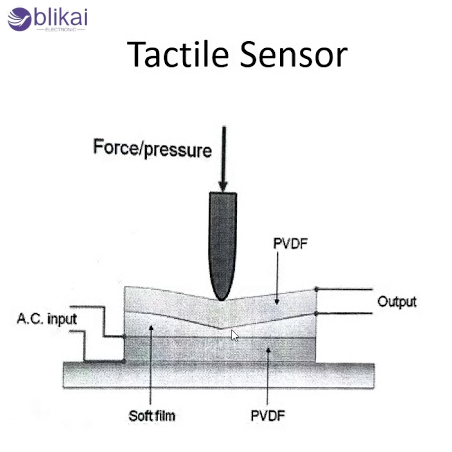
How Does a Tactile Sensor Work?
The working principle of a tactile sensor lies in the fact that mechanical deformation can be converted into an electrical signal using a number of sensing mechanisms: resistance change, capacitance variation, charge generation or optical displacement. When an external force is impressed on the sensor face, the sensing element is disturbed and changes in a physical manner, which changes an electrical property that can be quantified and characterized by signal-processing equipment.
Basic Working Principle of Tactile Sensors
At a fundamental level, a tactile sensor consists of a deformable sensing layer, a transduction mechanism, and signal-conditioning electronics. The sensing layer is deformed in line with the stimulus applied when there is force or touch. This distortion leads to quantifiable change of resistance, capacitance, voltage, light path or magnetic field. This signal is amplified, filtered, digitized and processed in order to obtain significant tactile data like magnitude of force, location of contact or texture pattern.
Key Physical Quantities Measured
The sensors are tactile and have the ability to sense many physical values at the same time, such as normal force, pressure distribution, shear force, vibration, contact area, and micro-texture. This multi-parameter sensing feature gives tactile sensors the ability to differentiate between soft and hard objects, detecting slipping or rolling motion, and detecting the surface features that cannot be detected using simple touch or pressure sensors.
Main Types of Tactile Sensors
The tactile sensors may be defined based on the sensing technology used in each, which has varying performance features, strengths, and weaknesses.
Resistive Tactile Sensors
Resistive tactile sensors work based on changes in the electrical resistance of mechanical deformation of a conductive or semiconductive substance. When force is exerted, the resistance is decreased with the force applied by compressing the conduction path. These sensors are simple, low-cost, and easy to interface with microcontrollers, making them popular in basic tactile arrays and flexible sensor mats, although they may suffer from hysteresis and long-term drift.
Capacitive Tactile Sensors
Capacitive touch sensors, touch or force detectors, measure capacitance change between conductive plates that are divided by a dielectric material. Mechanical pressure disturbs the distance/effective area between the plates, and a capacitance change is measured. Capacitive tactile sensors are sensitive, have high response time and repeatability, and hence are applicable in high-resolution tactile imaging and human-machine interfaces.
Piezoelectric Tactile Sensors
Tactile sensors consist of piezoelectric sensors, which are piezoelectric materials (quartz or some ceramic and polymers) whose mechanical stress produces an electrical charge. Such sensors are very good with dynamic forces, vibrations, and impact events. Nevertheless, they cannot be used to measure the static forces as much as the charge created goes off with time.
Optical Tactile Sensors
Optical tactile sensors are optical sensors that measure deformation in a transparent or semi-transparent medium that contains a photodetector and a light source. When force is applied, the internal light path changes, and the resulting optical signal is processed to reconstruct force distribution and contact geometry. Very high spatial resolution is offered by optical tactile sensors, which are extensively utilized in advanced robotic grippers and research studies.
Magnetic Tactile Sensors
Magnetic tactile sensors are based on the movement of a magnetic object and the resulting magnetic field variation, which is measured by a Hall-effect sensor. These sensors are durable, not sensitive to environmental effects and can be used in severe industrial conditions, but have lower resolution than optical or capacitive systems.
Key Components of a Tactile Sensor System
A complete tactile sensor system includes not only the sensing element but also supporting electronics and data-processing components.
Sensing Element
The sensing element forms the central part, directly connected to the mechanical input. It can be made of conductive rubber, elastomers, piezoelectric substances, flexible polymers, or micro-structured surfaces to make them sensitive and have a high level of spatial resolution.
Signal Conditioning Circuit
Signal conditioning circuitry amplifies sensor signals that are weak, eliminates noise, compensates temperature effects and converts analog signals into digital signals. To make tactile measurements stable and accurate, appropriate signal conditioning is required, particularly in low-force applications.
Processing and Output Interface
The processed tactile data is handled by microcontrollers, digital signal processors, or embedded AI systems, which interpret the sensor output and transmit it through interfaces such as I²C, SPI, UART, or CAN for integration into larger systems.
Tactile Sensor vs Touch Sensor vs Pressure Sensor
These sensors are usually mixed up, but they have greatly different functions, complexity, and the scope of application.
Tactile Sensor vs Touch Sensor
A touch sensor is meant to identify when contact or no contact is present; it may operate on capacitive or resistive technology, whereas a tactile sensor gives fine details about the force magnitude, distribution and interaction dynamics. Tactile sensors are high-resolution and multidimensional compared to binary or low-resolution touch sensors.
Tactile Sensor vs Pressure Sensor
Pressure sensors measure force per unit area applied uniformly across a sensing surface, usually providing a single scalar value. In contrast, tactile sensors can detect localized force distribution, shear forces, and surface texture, enabling advanced interaction analysis.
Comparison Table: Tactile vs Touch vs Pressure Sensor
|
Feature |
Tactile Sensor |
Touch Sensor |
Pressure Sensor |
|
Primary Function |
Detect force, texture, interaction |
Detect contact or proximity |
Measure pressure magnitude |
|
Data Output |
Multi-dimensional |
Binary or low-resolution |
Single scalar value |
|
Force Distribution |
Yes |
No |
Limited |
|
Texture Detection |
Yes |
No |
No |
|
Typical Resolution |
High |
Low |
Medium |
|
Common Applications |
Robotics, prosthetics, HMI |
Touchscreens, control panels |
Industrial & medical sensing |
Common Applications of Tactile Sensors
Robotics and Robotic Grippers
In robotics, to control grip force, slip, and manipulate delicate or irregular objects, robot hands and gripper fingers must have a tactile sensor. Service robots, industrial automation and collaborative robots must have this ability to work with humans.
Medical and Healthcare Devices
Prosthetic limbs have tactile sensors that are popular in the field of providing sensory feedback to users so that they can experience the grip strength and contact with objects. They are also in minimal invasive surgical instruments and rehabilitation machines, where force control is very important.
Consumer Electronics
In consumer electronics, tactile sensors enhance user experience through haptic feedback, pressure-sensitive buttons, and advanced touch interfaces in smartphones, wearables, and gaming devices.
Industrial Automation
Tactile sensors are employed in industrial systems to carry out quality control, verify assembly and to monitor safety since machines can recognize the presence of abnormal force during contact or a misplaced component.
Automotive and Smart Transportation
Tactile sensors find applications in automotive applications in areas such as control panel, seat occupancy system, steering system and advanced driver-assistance system to enhance safety and ergonomics.
Advantages of Tactile Sensors
Intelligent systems can have a high level of control, interaction and adaptive behavior through the use of tactile sensors, which store rich, human sensory information. Their ability to measure multiple physical parameters simultaneously makes them indispensable in advanced applications.
Disadvantages of Tactile Sensors
Although they are beneficial, tactile sensors are costly, complicated with respect to customization, and sensitive to other environmental conditions like temperature and humidity. Stability and durability are issues, especially when it comes to flexible and soft sensors.
How to Choose the Right Tactile Sensor
Measurement Range and Sensitivity
To choose a tactile sensor, it is necessary to balance the force range and sensitivity with the task at hand and select the sensor correctly so as to detect the object one wants without saturation or noise problems.
Resolution and Response Time
The key feature of high-resolution sensors is texture recognition and precision control, whereas high-speed response in dynamic systems, like robotics and haptics, is an important attribute.
Environmental and Mechanical Considerations
Operating temperature, exposure to moisture, mechanical stress and projected lifetime are some factors that need to be taken into account so that the performance in real-life conditions can be reliable.
Future Trends in Tactile Sensor Technology
The latest tendencies in the area of tactile sensing are the creation of flexible and stretchable sensors, electronic skin (e-skin), AI-driven tactile perception, and integration with machine learning algorithms. Such developments are facilitating a more natural human- machine interaction and speeding up robotics, medical and other smart devices innovation.
FAQ
Are tactile sensors the same as pressure sensors?
Not, tactile sensors are more multidimensional than pressure sensors, which measure only the magnitude of pressure.
Can tactile sensors detect texture and shape?
Yes, advanced tactile sensors can detect surface texture, shape, and even material properties through high-resolution sensing arrays.
Conclusion
Tactile sensors are an important development in sensing technology, and they allow electronic systems to detect and comprehend physical interaction in a new level of detail. Knowing their working principles, types, benefits, and uses, engineers and designers can use tactile sensors to design smarter, safer and more user-friendly electronic systems in a wide variety of industries.
Some images are sourced online. Please contact us for removal if any copyright concerns arise.





