


Darlington Transistor Explained: Working, Specs & Applications
 373
373Introduction to the Darlington Transistor
A Darlington transistor is a special form of bipolar junction transistor (BJT) design that makes use of two transistors in one composite device to achieve very high current gain. Contrasting with a standard BJT, which might be required to provide a relatively large base current to power large loads, a Darlington transistor can be driven by very small amounts of input current by logic circuits, sensors or microcontrollers and used to control high-current devices like relays, motors, solenoids and lamps.
What Is a Darlington Transistor?
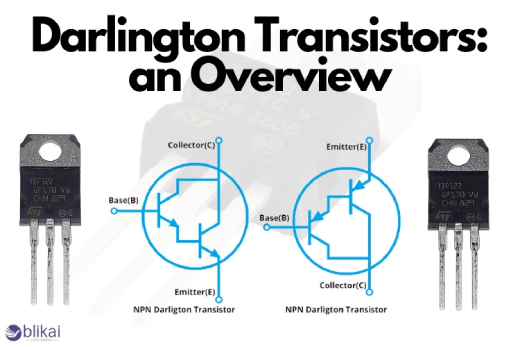
A Darlington transistor is formed by connecting two bipolar transistors so that the emitter of the first transistor feeds directly into the base of the second transistor, while their collectors are tied together. This configuration has the advantage of multiplying the existing gain (hFE or b) of the two transistors, which has a compounding effect to a maximum possible gain of several thousand. The Darlington transistor is functionally equivalent to a single transistor with very large gain, and therefore has the capability to enable very small base currents to be converted into very large collector currents to power loads.
How a Darlington Transistor Works
Current Amplification Mechanism Explained
The peculiar feature of a Darlington transistor is its very high current gain. If the first transistor has a gain of β₁ and the second has a gain of β₂, the total gain of the Darlington pair is approximately β₁ × β₂. This implies that base currents of a few microamps or milliamps may cause collector currents of amperes or more, depending on the device rating, and as such, Darlingtons are best suited to control circuits that require small currents.
Input–Output Signal Flow
Upon the small current being injected into the base terminal, it will activate the first transistor, and the current that has been amplified by that transistor will cause the base of the second transistor to be driven. This current is further amplified by the second transistor, and a large collector current is permitted to be carried through the load. Systematically, the Darlington transistor acts as a current-controlled switch or amplifier, which is extremely sensitive.
Voltage Drop Characteristics
Their high base-emitter and collector-emitter saturation voltage are also a significant feature of Darlington transistors. Because two base-emitter junctions are effectively in series, the base-emitter voltage typically ranges from 1.2 V to 1.4 V, compared to about 0.7 V for a single BJT. And in a similar manner, the collector-emitter saturation voltage is increased, leading to higher power dissipation and lower efficiency.
Electrical Characteristics and Specifications
Current Gain (hFE) and Input Sensitivity
Darlington transistors typically exhibit current gains ranging from several hundred to several thousand, far exceeding those of standard BJTs. This high gain allows them to be driven directly by logic outputs, optocouplers, or low-level sensor signals without additional amplification stages.
Collector Current and Voltage Ratings
Depending on the model, Darlington transistors can be used with collector currents of a few hundred milliamps to a couple of amps and collector-emitter voltages of 30 V to greater than 100 V. Power Darlington transistors are commonly used with collector currents of a few hundred milliamps to a couple of amps and collector-emitter voltages of 30 V to more than 100 V.
Saturation Voltage and Power Dissipation
Due to the higher saturation voltage, Darlington transistors dissipate more power when fully on compared to single BJTs or MOSFETs. This additional loss of power should be considered by the designers, and sufficient heat sinking should be done, in particular when operating with continuous-current.
Switching Speed and Frequency Limitations
The overall speed of the Darlington transistors is slower than that of single BJTs due to the charge storage present in the two-transistor structures. This causes them to be inappropriate at high frequency or rapid switching, yet entirely suitable at low frequency switching, DC control, and linear amplification.
Types of Darlington Transistors
NPN vs PNP Darlington Transistors
Darlington transistors are available in both NPN and PNP configurations. NPN Darlingtons are more common and tend to be used in low-side switching, but PNP Darlingtons are used in high-side switching with the load connected to the ground.
Discrete Darlington Transistor Packages
Discrete Darlington transistors are packaged in small packages as small as TO-92 packages used in low power applications, to larger TO-220 packages and TO-247 packages used in high current applications. Package selection directly affects thermal performance and mounting options.
Darlington Transistor Arrays
Integrated Darlington arrays, such as the ULN2003 and ULN2803, contain multiple Darlington pairs in a single IC and often include built-in base resistors and flyback diodes. Microcontrollers are commonly used to drive inductive loads, relays and stepper motors with these arrays.
Popular Darlington Transistor Models
TIP120 / TIP122 / TIP127 Overview
TIP120 (NPN), TIP122 (higher voltage NPN) and TIP127 (PNP) are the most popular Darlington transistors. They are known to be robust, easy-to-use and industry and hobby-client-friendly designs.
BC517 and Small-Signal Darlingtons
For low-current, high-gain applications, small-signal Darlington transistors like the BC517 offer very high amplification in compact packages, making them suitable for sensor interfaces and signal conditioning circuits.
ULN Series Driver ICs
ULN-series ICs integrate multiple Darlington transistors with protection components, significantly simplifying multi-channel driver designs in automation and embedded systems.
Darlington Transistor vs Single BJT
Gain Comparison and Drive Requirements
A Darlington transistor also needs much lower base current to attain the same collector current, and is therefore less demanding to control in the control circuitry.
Efficiency and Voltage Drop Differences
The trade-off for higher gain is increased voltage drop and power loss, making Darlingtons less efficient than single BJTs in some applications.
Use-Case Selection Guide
Darlington transistors are preferred when control current is limited, and efficiency is less critical, while single BJTs are chosen when a lower voltage drop is required.
Darlington Transistor vs MOSFET
Control Method and Input Impedance
Darlington transistors are controlled devices where the value of the current is controlled, and the transistors are voltage-controlled with very high input impedance that makes MOSFETs more effective in many current designs.
Switching Speed and Efficiency
MOSFETs generally switch faster and have lower conduction losses, but Darlington's remain attractive for simple, low-cost, low-frequency designs.
Application-Based Comparison
In educational, legacy, and industrial circuits, Darlington transistors are commonly used, whereas MOSFETs are used in high-efficiency and high-speed applications.
Common Applications of Darlington Transistors
Relay and Solenoid Drivers
Darlington transistors are widely used to drive relays and solenoids because they can be controlled directly from low-current logic outputs.
Motor and Actuator Control Circuits
In DC motor and actuator control, Darlingtons provide sufficient current gain to handle motor loads with minimal control circuitry.
LED and Lamp Drivers
Darlingtons are good at driving LED strings or incandescent lamps where the speed of switching is not very important.
Audio and Signal Amplification
Darlington pairs are sometimes used in audio output stages and buffer amplifiers to provide high current drive capability.
Typical Darlington Transistor Circuits
Basic Darlington Switch Circuit
A basic Darlington switch is a low-frequency switch based on a simple Darlington switch. It consists of a base resistor to limit input current, and a load to which the collector is connected.
High-Current Load Control Example
For inductive loads, a flyback diode is added to protect the transistor from voltage spikes, a common practice in relay and motor driver circuits.
Microcontroller Interface Circuit
Darlington transistors are sometimes connected directly to microcontrollers such as Arduino to power loads that are beyond the current capability of the MCU.
Advantages of Darlington Transistors
The main advantages include extremely high current gain, simple circuit design, and compatibility with low-level control signals.
Disadvantages of Darlington Transistors
Power Loss Mechanisms
The increased saturation voltage results in more power loss, and this has to be controlled to avoid thermal runaway.
Heat Sink and Package Selection
In order to ensure good reliability in medium- and high-current conditions, good package selection and heat sinking are essential.
How to Choose a Darlington Transistor
Selecting by Current, Voltage, and Gain
Designers are required to choose a Darlington transistor in view of load current, voltage rating, and gains required.
Package and Mounting Considerations
Mechanical mounting and thermal design are as important as electrical specifications.
Common Mistakes When Using Darlington Transistors
- Ignoring Saturation Voltage
- The voltage drop may not be considered and may result in an inadequate load voltage.
- Overlooking Thermal Limits
- Lack of cooling may cause a breakdown of the devices.
- Darlington's High-Speed Switching.
- Darlingtons cannot be used in high-frequency applications.
FAQs
What is the voltage drop of a Darlington transistor?
The base-emitter voltage is typically 1.2–1.4 V, and the collector-emitter saturation voltage is higher than that of a single BJT.
Is a Darlington transistor better than a MOSFET?
A Darlington transistor is less efficient but easier to operate and use than a MOSFET, and each is suited to different applications.
Can Darlington transistors be used with Arduino?
Yes, they are commonly used with Arduino and other microcontrollers to drive high-current loads safely.
Conclusion
Darlington transistors are still used in high-gain and low-frequency and low-complexity designs, particularly in control and driver designs where convenience is more important than efficiency considerations.
Some images are sourced online. Please contact us for removal if any copyright concerns arise.





