


Battery Isolator for Dual Battery Electronic Systems
 460
460Introduction
A dual-battery system is one of the smartest upgrades for vehicles, RVs, marine electronics, and off-grid setups—but without proper isolation, the auxiliary battery can accidentally drain the main starter battery and leave the system powerless. A battery isolator is a device that assures you that both batteries are powered efficiently and that the starter battery is not discharged unnecessarily, such that you have safe, reliable power to power lights, radios, fridges, winches and navigation devices.
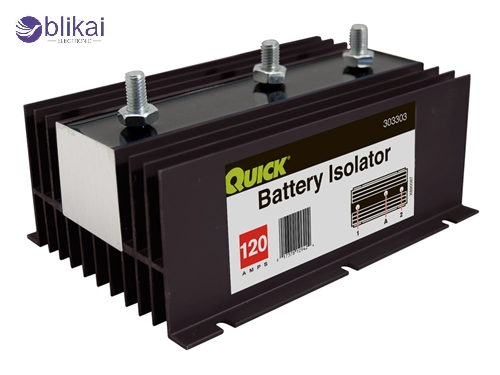
What Is a Battery Isolator?
A battery isolator is an electronic device that lets you charge two (or more) batteries from a single power source—usually an alternator or charger—while keeping the batteries electrically separated when not charging. This is to ensure that a battery does not draw power from the other. In dual-battery systems, a traffic controller is the isolator, whereby when the current is required, it is permitted to pass, but when it is harmful, it is prevented.
How Does a Battery Isolator Work?
The battery isolator is a circuit that utilizes a diode, a relay, an MOSFET or a voltage-dependent switch to control the flow of current between two or more batteries. The isolator will be able to connect the batteries to the power supply with a charging voltage, and once the charging is completed the isolator will automatically disconnect the batteries. This guarantees that every battery does not take the energy unless it is safe and provides energy only to its load.
Why Does It Prevent Battery Drain?
Isolators are used to prevent reverse current flow and so the drainage of an accessory battery by the starter battery. This makes certain that the engine battery is completely charged to turn the engine even when auxiliary electronics are turned on like refrigerators, radios or LED lighting which are on during hours.
What Types of Battery Isolators Are Used?
The most widespread ones are diode isolators, solenoid/relay isolators, VSR/ACR smart isolators, and MOSFET solid-state units. Each of the types is efficient, has a current capacity and is compatible with modern alternators.
Battery Isolator Types Comparison Table
|
Isolator Type |
How It Works |
Pros |
Cons |
Best For |
|
Diode Battery Isolator |
Uses high‑current diodes to split charging current to multiple batteries while preventing backflow. |
Simple, reliable, no moving parts, prevents cross‑discharge. |
Voltage drop (0.6–0.7V), reduced charging efficiency. |
Marine systems, RVs with simpler alternator setups. |
|
Solenoid / Relay Battery Isolator |
Uses an ignition‑controlled or voltage‑sensing relay to connect/disconnect batteries. |
Low cost, minimal voltage drop, supports high current. |
Has moving parts, may wear over time, requires ignition/trigger wiring. |
Automotive dual‑battery systems, off‑road vehicles. |
|
MOSFET / Solid‑State Battery Isolator |
Uses MOSFET transistors to allow current flow with ultra‑low voltage drop. |
Very low loss, efficient charging, no moving parts. |
More expensive, sensitive to heat and improper wiring. |
Modern dual‑battery systems, lithium battery setups, high‑efficiency charging. |
What Are the Advantages of Using a Battery Isolator?
Does It Extend Battery Life?
Yes. A battery isolator will allow deep discharge to be avoided, will safeguard battery health, and will provide balanced charging, which is of particular concern to AGM, gel, and lithium batteries.
How Does It Improve System Reliability?
By separating critical loads, an isolator ensures that navigation lights, radios, or emergency systems remain powered even if auxiliary batteries become discharged.
Why Is It Essential for Dual-Battery Setups?
There is no isolation and a dual-battery can have a failure easily. The isolator keeps the starter battery in a healthy condition, and the auxiliary loads are taken off the secondary battery only.
Where Are Battery Isolators Commonly Used?
Automotive Dual Battery Systems
Battery isolators are popular in trucks, SUVs and overlanding vehicles to ensure that the starter battery is not damaged during operation of high-consumption accessories. They give the capability to operate winches, light bars, fridges, and air compressors without compromising the ability to start the engine. This system is perfect for off-road use since it has a stable cranking capacity even when the accessory loads are run for long periods. All emergency and utility vehicles also employ the use of isolators in order to ensure that radios and equipment installed on the vehicles operate without interruption.
Marine Electronics and Navigation Systems
Marine ships have battery isolators to isolate the engine starter battery from the house battery, which drives the navigation electronics and cabin systems. This avoids the need for equipment that would drain the battery that would be required to start the engine, like chartplotters, radios, bilge pumps and lighting. Since boats tend to spend a lot of time on anchor, isolators provide constant power to devices in the boat, but at no harm to the engine battery. They are also vibration-resistant and corrosion-resistant, making them fit the harsh marine environment.
RV and Caravan Power Systems
RVs rely on battery isolators to manage house loads like refrigerators, fans, pumps, and lighting without impacting the chassis battery. The isolator then charges both batteries during the driving period and separates them automatically during engine engine-off period to avoid unnecessary discharge. This allows the campers to use appliances at night, do solar charging together with alternator charging, and use inverters to charge items with a high AC load safely. It is an essential part of the modern RV electrical systems where multi-source charging is frequent.
Solar Energy Storage and Off-Grid Systems
Isolators are used to control several battery banks in off-grid power installations to prevent the likelihood of flowing of energy in both directions. This is especially important when different chemistries or different charge states are used, as it avoids cross-discharging and uneven battery wear. Isolators help solar controllers distribute charge efficiently while protecting backup or emergency batteries. They are widely used in cabins, portable solar stations, telecom equipment, and remote monitoring systems.
How to Choose the Right Battery Isolator?
What Current Rating Do You Need?
Choose an isolator that meets or exceeds the output of your alternator. High-output alternators (180A–250A) require heavy-duty isolators.
Which Type Fits Your Application?
- Diode isolator → Best for high reliability, marine environments
- Relay isolator → Best for budget builds and high-current loads
- VSR → Best all-around choice for automotive and RV
- MOSFET isolator → Best for lithium systems and modern vehicles
Does Battery Chemistry Matter?
Yes. The various chemistries demand varying charging characteristics, and intelligent isolators or MOSFET isolators perform best in such situations.
What Installation Conditions Should You Check?
Heat, vibration, moisture, and limited mounting space influence isolator selection. Marine-grade isolators require sealed construction.
How to Install a Battery Isolator Safely?
What Tools and Components Are Required?
Types of cables, inline fuses, ring terminals, heat shrink tubing, and voltmeter are normally required to test.
Wiring Steps for Dual Battery Systems
- Connect alternator → isolator input.
- Connect isolator outputs → each battery.
- Install fuses within 6–12 inches of the batteries.
- Ground both batteries properly.
- Test charging voltage on both banks.
Common Installation Mistakes to Avoid
- Using undersized cables
- Forgetting fuses
- Loose or corroded battery terminals
- Poor grounding
- Incorrect polarity connections
Battery Isolator vs. DC-DC Charger: Which Is Better?
When Should You Use an Isolator?
A battery isolator should be used where an alternator has large output, loads are large current, or where a low-cost solution is needed.
When Is a DC-DC Charger Superior?
DC-DC chargers will work better with lithium batteries, smart alternator vehicles, or long cable runs. They offer regulated multi-stage billing.
Troubleshooting Battery Isolator Problems
Why Is the Auxiliary Battery Not Charging?
This is typically the indication of loose wiring, broken fuse, low performance by the alternator or a broken internal relay.
Why Does the Vehicle Battery Drain Overnight?
Possible causes include a faulty isolator, a stuck relay, parasitic loads bypassing the isolator, or incorrect wiring.
How to Test an Isolator with a Multimeter?
Check voltage of the alternator, continuity test across the relay terminals, and voltage measurement in every battery under load.
FAQs
Can a battery isolator charge two batteries at the same time?
Yes--isolators are created with the express purpose of charging more than one battery at a time, keeping them electrically isolated.
Does a battery isolator reduce alternator power?
Diode isolators have a voltage drop added, but MOSFET and relay isolators have very little loss.
Is a VSR better than a diode isolator?
For most modern vehicles, yes. VSRs avoid voltage drop and offer automatic operation.
Do I need an isolator for a lithium auxiliary battery?
Yes—lithium batteries must never back-feed the starter battery. It is suggested to use MOSFET isolators or DC-DC chargers.
Conclusion
A battery isolator is something that every two-battery electronic system must have, it will keep the battery that powers the starter safe and allow the car to run stably and safely with its accessories. It is not only when you are on the waterpowering marine navigation systems, but also onshore charging overlanding equipment and RV appliances that the correct isolator will give you dependable charging, battery drain prevention, and long-term system maintenance.
Some images are sourced online. Please contact us for removal if any copyright concerns arise.





