


Reed Switch Guide: Working Principle, Types & Applications
 676
676Introduction to Reed Switches
Reed switches are magnetically actuated electromechanical components widely used in sensing, control, and low-power electronic systems due to their simple structure, high reliability, and zero standby power consumption. Although solid-state sensors are rapidly increasing, reed switches have their place in automotive electronics, industrial automation, security systems, medical devices, and IoT applications, with such characteristics as isolation, robustness, and long-term stability being paramount. Their capability to work without a power source and their ability to withstand adverse conditions renders them a long term solution for position, proximity and state recognition in contemporary electronic construction.
What Is a Reed Switch?
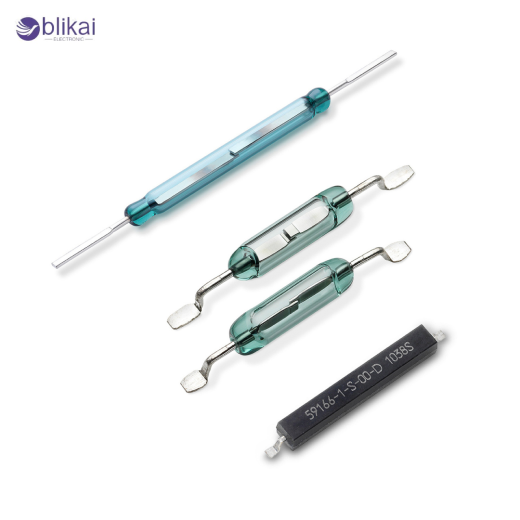
A reed switch is a passive, electrical type of switch that functions due to an external magnetic field and is made up of two metal reeds of ferromagnetic material enclosed in a hermetically sealed glass capsule. Using a magnetic field, the reeds will become magnetized and attract or repel each other in the presence of a magnetic field, opening or closing the switch contacts. Because the switching action is magnetically driven and electrically isolated, reed switches are often classified as both sensors and switching components, bridging mechanical reliability with electronic simplicity.
Basic Structure of a Reed Switch
A reed switch can be made of a nickel-iron alloy, and its internal structure consists of two thin and overlapping ferromagnetic reeds in a glass tube that is filled with an inert gas or even a vacuum to avoid oxidation and contamination. The electrical insulation and environmental protection are done by the glass envelope, and the plated reed contact tips ensure the low contact resistance, and the switching behavior is stable. Lead wires extend from both ends of the capsule for through-hole or surface-mount integration, and the overall construction enables fast response times, high insulation resistance, and consistent performance over millions of operations.
Reed Switch Working Principle
The working principle of a reed switch is based on magnetic flux-induced actuation, where an external magnetic field—typically generated by a permanent magnet or electromagnet—magnetizes the ferromagnetic reeds, causing them to move mechanically. In a normal open system, the reeds repel each other and close the circuit when enough magnetic field is applied to them, whereas in normal closed systems, the magnetic field pushes the contacts away. After the magnetic field is turned off, the reeds will be back to their original position since they have an elastic restoring force, and the contact-free actuation can be repeated and performed without having electrical power.
Types of Reed Switches
Normally Open (NO) Reed Switch
Normal reed switches are electrically open, meaning they need a magnetic field to close, and are available in the widest form because they are the most common type of proximity sensor, position sensor and on/off switch. Their default open state reduces the unwanted unintentional flow of current, and this is particularly beneficial in safety-critical and battery-powered systems.
Normally Closed (NC) Reed Switch
Normally closed reed switches will have a closed circuit normally and will open when a magnetic field is present, enabling their application as a fail-safe device in an alarm system, safety interlock or tamper-detection circuit. This arrangement is so that in case of a fault in a system, a broken wire or a component failure, this fault is identified.
Changeover (SPDT) Reed Switch
Changeover or SPDT reed switches combine normally open and normally closed contacts into a single device, enabling more complex switching logic such as signal routing, state inversion, or redundancy monitoring. These switches are often used in industrial control and instrumentation systems where multiple output states are required.
Surface-Mount and Form-Factor Variants
Reed switches are available in both axial-leaded and radial and surface-mounting packages with the miniature and ultra-miniature package sizes being available to fit into the small PCBs. Surface-mount reed switches support automated assembly and high-density layouts, while encapsulated or ruggedized versions provide additional mechanical protection for industrial and automotive environments.
Key Electrical and Mechanical Specifications
Important reed switch specifications include contact rating, switching voltage and current, maximum carry current, contact resistance, and insulation resistance, all of which determine electrical compatibility with the target circuit. Magnetic sensitivity is specified by operate and release values measured in ampere-turns (AT), defining the required magnetic field strength for actuation. Mechanical parameters such as operating time, bounce time, and expected life cycles—often exceeding billions of operations under low-load conditions—are equally critical when designing reliable systems.
Reed Switch vs Hall Effect Sensor
In comparison between reed switches and Hall effect sensors, reed switches have the benefit of having zero power consumption, galvanic isolation, and reduced interface requirements, whereas the Hall sensors have high switching speeds, no mechanical wear and increase resistance to vibration. Reed switches are normally used in cases of low power, cost-sensitive, and safety concerns, whereas Hall sensors are more effective in high-speed, high-frequency or digitally integrated systems where continuous power is not of importance.
Advantages of Reed Switches
The main benefits of reed switches are passive operation, no power, low contact resistance, high electrical isolation, long life, and dependable use in severe conditions, like moisture, dust and extreme temperatures. Their minimal construction minimises the failure points, and they are hermetically sealed to avoid corrosion and contamination and are therefore especially used in industrial, automotive and outdoor applications.
Disadvantages of Reed Switches
In spite of the advantages, the reed switches have some disadvantages, which include mechanical contact wear, shock and vibration sensitivity, a lower switching rate than solid state devices, and external strong magnetic fields can interfere with their operation. Careful mechanical mounting and magnetic field control are required to avoid false triggering or contact sticking in demanding environments.
Common Applications of Reed Switches
Reed switches find application in a diverse industry due to their dependable, low-cost magnetic sensing that does not require complicated electronics.
Automotive and Transportation Systems
In automotive electronics, reed switches are used for door and hood position detection, seatbelt status monitoring, fluid level sensing, and speed measurement in older or auxiliary systems, where robustness and electrical isolation are critical.
Security and Alarm Systems
Reed switches are a core component of door and window sensors in intrusion detection systems, where a magnet-reed pair reliably detects unauthorized opening while consuming no standby power.
Industrial Automation and Control
Limit switches, position feedback, conveyor monitoring and safety interlocks are industrial examples where reed switches have been used to offer consistent operation in electrical noise and severe environmental conditions.
Consumer Electronics and Smart Devices
In consumer and smart home devices, reed switches enable lid detection, accessory attachment sensing, and low-power wake-up functions in appliances, wearables, and connected products.
Medical and Healthcare Equipment
Medical devices use reed switches for contactless switching, fluid level detection, and implantable system control, benefiting from their reliability, low EMI generation, and compatibility with sterilized environments.
Reed Switch Selection Guide
The choice of reed switch requires matching the magnetic sensitivity, electrical ratings, package type and environmental criteria with the application, although the magnet strength, the operation distance and mechanical alignment are to be taken into account. Excessive switching load type (either resistive or inductive) should also be considered by the designers in order to guarantee long contact life and consistent operation.
Installation and Mounting Considerations
To be installed properly, the magnet placement should be correct, the air spaces should be controlled, the vibration should be isolated, and the PCB should be properly mounted so as to avoid stress on the glass capsule. Magnetic shielding, damping materials, and proper lead forming techniques are all that can be done to enhance reliability and minimise false triggering.
Reliability, Lifetime, and Failure Modes
Reed switch reliability is influenced by contact wear, overcurrent damage, mechanical shock, and glass envelope integrity, with common failure modes including contact sticking, contact erosion, and mechanical fracture. Operating within rated limits and using protective circuits such as flyback diodes for inductive loads greatly extends service life.
Reed Switches in Modern IoT and Low-Power Designs
Reed switches are now being deployed (in increasing numbers) as ultra-low-power triggers, wake-up sensors and state detectors in IoT, multi-year-battery life battery-powered devices and in battery-free maintenance-free devices, as they consume no energy until actuated.
Future Trends in Reed Switch Technology
The future of the reed switch technology is miniaturization, enhanced contact materials, increased power capabilities, and hybrid models adopting a combination of the reed switch and solid-state electronics to increase durability without compromising the passive operation qualities of the device.
FAQ
How long does a reed switch last?
In low electrical load conditions, a reed switch may have billions of operations with its lifetime based upon current, voltage, and mechanical stress.
Are reed switches better than Hall effect sensors?
Reed switches are more appropriate in low-power, simple and isolated applications, whereas Hall effect sensors are more appropriate in high-speed and high-frequency or digitally integrated designs.
Some images are sourced online. Please contact us for removal if any copyright concerns arise.





