


Crimp Connectors: Wiring Types, Specs & Install Tips
 899
899What Are Crimp Connectors?
Crimp connectors are mechanical wire terminals used to create strong, low-resistance electrical connections by compressing a metal barrel around a stripped wire. It is a process that removes soldering and guarantees a uniform bond free of vibration that is suitable for automotive, marine, industrial, and appliance wiring. Reliability is based on the requirement to match the connector size, wire gauge, insulation, and an appropriate crimping tool.
Common Types of Crimp Connectors
Butt Connectors
Butt connectors are used to splice two wires together at their end in order to form a strong splice. They are offered with insulated, non-insulated and heat-shrink options to allow them to fit a variety of installation environments and protection values. Color coded enables easy matching of wire gauge, whereas the types of heat-shrink provide moisture protection when the wire is to be used. They are easy to install, and their design is simple; the barrel shape, combined with their powerful resilience to vibration, makes them highly applicable in automotive repair, appliance, marine, and general wiring.
Spade Connectors (Fork Terminals)
Spade connectors have a U-shaped opening which can be installed under a screw terminal but not fully removed, so that they can be installed and serviced quickly. Their contact will not bounce even when vibrated and are typical of HVAC devices, switchboards, sound systems, and industry. Available in PVC, nylon, and heat-shrink insulation, they support various gauges and provide flexibility for different environments.
Ring Terminals
Ring terminals offer the most secure connection by using a fully closed circular end that fits over a screw or stud. When fastened, they become resistant to vibration and hence are necessary in automotive batteries, grounding points, and high-current circuits when attached. They come in copper, tinned copper and heat-shrink with the added value of better conductivity and environmental friendliness.
Bullet Connectors
Bullet connectors use a male-and-female design to create a quick-disconnect interface that can be easily separated without tools. Their rounded shape ensures simple alignment, while friction between both sides maintains stability under vibration. Insulated and heat-shrink options improve safety and moisture resistance. Bullet connectors are commonly used in motorcycle wiring, automotive lighting, trailers, and DIY projects where parts require frequent removal or servicing.
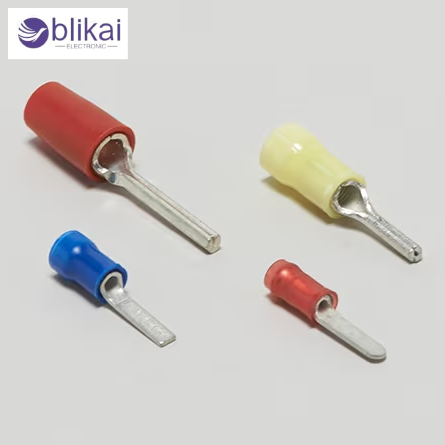
Pin Terminals
Pin terminals provide a clean way to insert stranded wires into terminal blocks and connector clamps designed for solid wires. They prevent wire fraying and ensure consistent pressure, improving wiring reliability in control panels and automation systems. Available in insulated and uninsulated versions, pin terminals help maintain neat, organized wiring layouts. They are widely used in PLC modules, relay terminals, and other low-voltage control circuits requiring compact, repeatable connections.
Specialty Crimp Terminals
Specialty crimp terminals serve demanding environments requiring improved sealing, heat tolerance, or mechanical strength. Such examples are heat-shrink connectors lined with adhesive to make them waterproof, high-temperature terminals in the engine compartments, and open-barrel terminals in OEM harnesses. Multi-pin connector systems such as Deutsch and weather-pack are sealed systems that protect against water, dust and chemicals. They are found in automotive, marine, aerospace and industrial systems where normal connectors can be unsuccessful.
Crimp Connector Specifications
Wire Gauge (AWG) Compatibility
AWG compatibility is essential since any two connectors are meant to have a particular range of wire sizes, which are compatible with each other. Improper use of size can lead to loose connection, overheating or electrical breakdown. Insulated connectors are color-coded, red, blue, and yellow, to make it easy to select the gauges when installing the connection.
|
Color |
Wire Gauge (AWG) |
Typical Use |
|
Red |
22–18 |
Sensors, low-voltage |
|
Blue |
16–14 |
Automotive circuits |
|
Yellow |
12–10 |
High-current loads |
|
Black / Green |
Special gauges |
Grounding |
Material Types
Connector materials influence conductivity, corrosion resistance, and durability. Copper offers high conductivity, while tinned copper adds corrosion protection for marine or humid environments. Brass provides cost efficiency but lower conductivity. Barrel thickness and plating quality also affect performance in high-vibration applications.
Insulation Options
Protection and environmental resistance are determined by insulation. PVC is the simplest abrasion-resistant material, nylon is stronger and higher in temperature, and the heat-shrink insulation is waterproof and best used in an outdoor or marine setting. In high temperature or compact installations, uninsulated connectors are applied.
Voltage and Current Ratings
The connectors are categorized into crimp connectors that are designed to accommodate certain levels of energy, voltage, and current based on their size, materials, and insulation. Circuits with high currents need terminals that are heavily loaded, barrel-shaped and made of materials with high conductivity. Dielectric strength and higher voltages are enhanced by heat-shrink insulation.
Environmental and IP Ratings
The ratings on the environment show that it is resistant to water, dust, chemicals and mechanical stress. Marine or outdoor applications of heat-shrink connectors may include a waterproof seal or a high IP rating. Adhesive or silicone moisture barriers are fitted on some terminals. Reinforced barrels and robust insulation in vibrating environments will highlight fatigue and failure, which will guarantee long-term stability.
How to Choose the Right Crimp Connector
Choosing the right connector requires evaluating wire gauge, insulation, conductor type, environmental conditions, and the circuit’s electrical load. Heat-shrink connectors are mostly applicable in outdoor or marine applications, whereas heavy-duty ring terminals are applicable to high-current paths. Pin terminals could be necessary in control panels. Finding a connector that matches the crimping tool, the crimping tool and the application makes sure that the performance is safe and durable.
Installation Guide: How to Crimp Connectors Properly
Tools You Need
A proper crimp requires ratcheting crimpers, wire strippers, and optionally a heat gun for heat-shrink connectors. Ratcheting crimpers provide a uniform amount of pressure and eliminate incomplete crimps, whereas matched wire strippers are able to leave the strands of the conductor not damaged. Other devices, such as cutters and continuity testers, are used to ensure the quality of connections.
Step-by-Step Crimping Process
Unstrip the wire to the proper length, and place the entire length inside the connector barrel and apply the same amount of pressure with the ratcheting crimper. In the case of heat-shrink connectors, the insulation is heated and sealed with heat. Crimp then check the connection to be fully pressed in the barrel and seated. Crimping must be done in an appropriate way that provides mechanical strength and low resistance.
Common Crimping Mistakes to Avoid
Some of the mistakes can be identified as the incorrect connector size used, crimping on insulation rather than conductor, overstripping the wire or the use of pliers rather than a good crimper. These defects undermine electrical contact and cause the possibility of failure. Do not combine incompatible materials, e.g., aluminum wire with copper terminals.
How to Test a Crimp Connection
Testing includes a pull test to check mechanical retention, visual inspection for proper compression, and electrical testing using a multimeter to confirm continuity. In critical systems, vibration or insulation-resistance testing may be required. Testing ensures reliable operation and helps identify installation issues early.
Applications of Crimp Connectors
Crimp connectors are widely used in automotive harnesses, marine wiring, industrial machinery, home appliances, solar systems, and audio equipment. They are also applicable in settings with vibrations, moisture or in settings requiring routine servicing due to their quick installation and stability. Crimp connectors serve a wide variety of electrical functions, including high-current battery cables and also control circuits of a delicate nature.
Crimp Connectors vs. Soldering
Crimping provides faster installation, better vibration resistance, and more consistent quality than soldering, especially in automotive and industrial environments. Soldering can create strong joints but requires more skill and is less suitable for high-movement applications. Crimping is preferred for mass production, field repairs, and systems requiring high mechanical strength.
FAQs
Are crimp connectors stronger than soldering?
Crimp connectors are often stronger in high-vibration environments because they form a gas-tight mechanical bond that resists loosening. Solder joints can crack under vibration, making crimps more reliable for automotive and industrial use.
Can crimp connectors be reused?
Crimp connectors are generally not reusable because the metal barrel deforms permanently during crimping. When they are reused, they may lead to poor contact or wire pullout.
What is the best crimping tool to use?
A ratcheting crimper would be advisable as it would offer stable pressure and avoid under-crimping and over-crimping.
When should I use heat-shrink connectors?
Marine, outdoor or wet area applications and environments need to be waterproofed with heat-shrink connectors.
Some images are sourced online. Please contact us for removal if any copyright concerns arise.





